I Don't Know Where I Am – CAT IIIB Landing (Part 1)
An evening Bangalore–Delhi A321 flight ends in an autoland through dense fog with RVR at minima — and a near-miss on the taxiway that shows how a single repeated word can almost cause a collision.
I DON'T KNOW WHERE I AM – CAT IIIB LANDING (PART 1)
On 20 January 2010, I operated an evening Bangalore–Delhi flight on an Airbus A321, departing at 1905 IST and cruising at FL360. The flight was uneventful until Top of Descent, with initial RVR at 900 metres for Runway 28.
Descending through FL270, the RVR fell rapidly to 500–300–200. Sensing it could soon drop to CAT IIIB minima (75/125/125), I increased descent speed to 320 knots. By FL190, it was 300/150/150. Only five aircraft continued, including us — the rest diverted.
At 10,000 feet, RVR reached 75/125/125. We requested short vectors (5 nm) and established on ILS. The fog that night was unusually dense. Callouts came — "1000… 500… 300… 200…" — no visual reference. At "100 feet"… still nothing. Then a faint yellow glow — the touchdown zone lights diffused through fog — and the autopilot landed the aircraft. We were the last to land. As we landed the airfield went below minima.
On the runway, visibility was under 50 metres. ATC asked our position. My response: "Somewhere on the runway… not sure where."
I called the lead cabin crew to the cockpit to brief. She entered, paused, and asked, "Captain, where are we?"
"Somewhere on the runway."
"How did you land?"
"Not me — the autopilot did."
With no follow-me vehicle available, we vacated via D1 and taxied slowly. Suddenly, two bright lights appeared, rushing straight at us through the fog. I shouted to ATC, "Stop, stop, … stop that vehicle!" — it had no idea we were there. A collision was narrowly avoided.
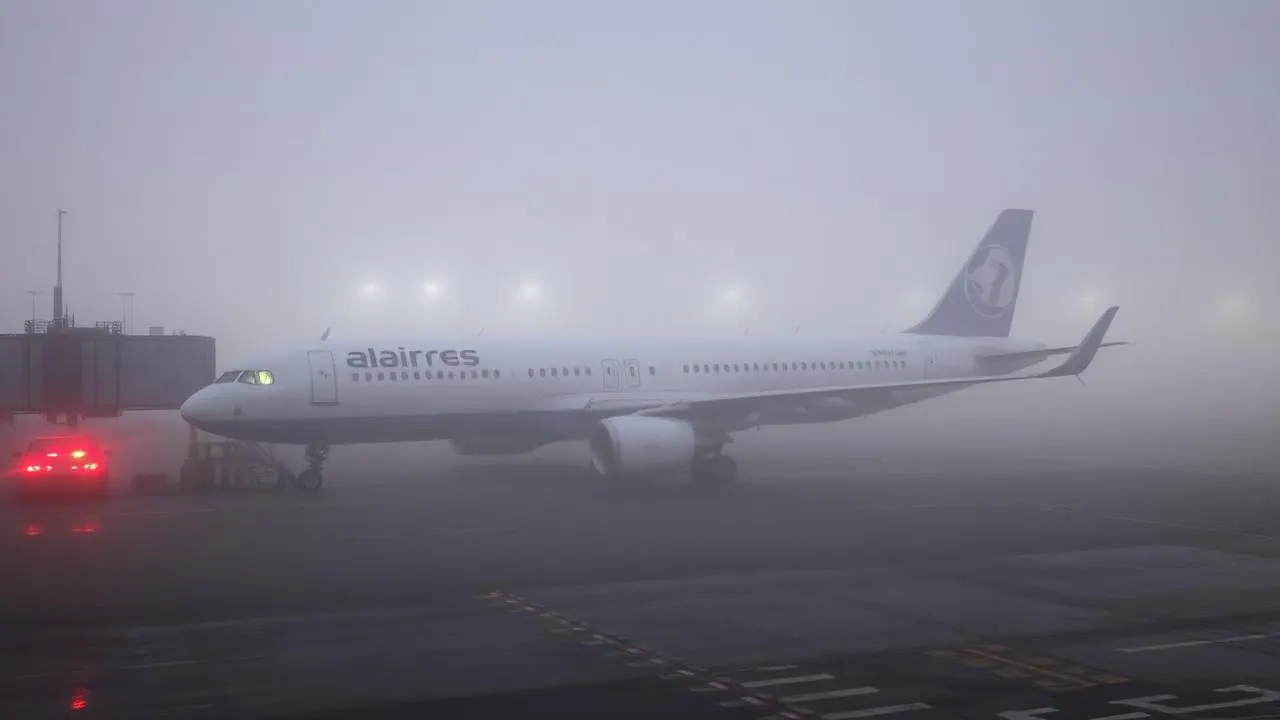
Further confusion followed regarding stand allocation. ATC instructed, "Proceed to stand one." The follow-me jeep, unsure, asked again. ATC repeated, "Stand one," and to emphasize, repeated "one." The follow-me jeep interpreted this as "one-one" (eleven). I followed the jeep. As it began turning in, the driver suddenly yelled, "STOP, STOP, … there is an aircraft parked here!" The repetition of "one" had led to confusion — highlighting how even minor communication errors can escalate in near-zero visibility. Along with the follow-me jeep we re-entered the main taxi track and proceeded to stand ONE.
After disembarking the passengers, the commercial and engineering staff came and informed me, "Captain, your transport is down below and you can go to the hotel. We need to secure the aircraft for the night."
All airlines had cancelled their flights for departure that night as the airfield was below minima, so I was told by the commercial team — but I chose to wait. I advised them, "If the wind picks up, the visibility will improve to 125 metres and we will go."
(Take-off and departure in Part 2)
Keep reading