Any Runway Is Fine
A monsoon route check on an A320 to Mumbai turns into a fuel-critical balancing act between thunderstorms, shifting runways and gusting crosswinds — and a quiet lesson in calm leadership.
ANY RUNWAY IS FINE
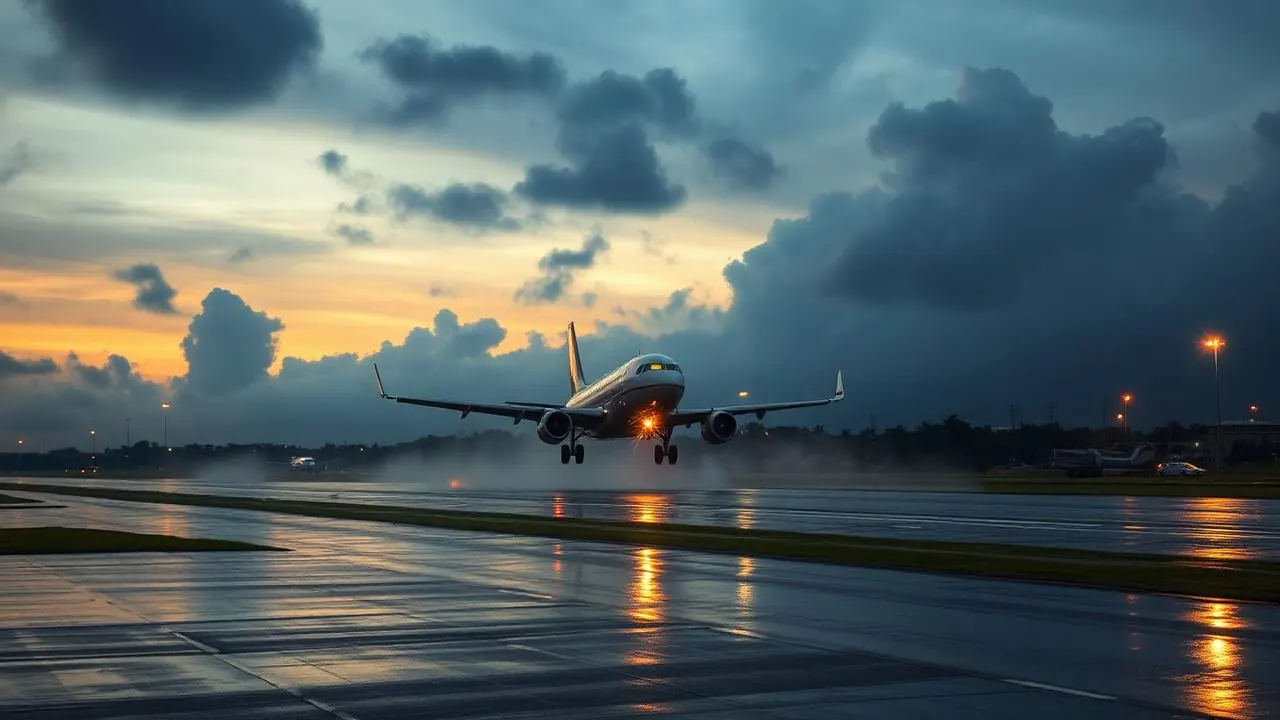
It was the monsoon season, year 2015. The flight was from Bangalore to Bombay on an A-320, a route check for a senior ex-pat pilot in his mid 50s who had been flying in the airline for several years. The departure was at 1700 IST. The flight was uneventful until vectoring for the ILS approach for runway 27 at Mumbai. The visibility was 800 m, winds 300/15 kts and heavy rain.
While on the intercept course at 5500 ft for intercepting the localizer, ATC asked us to discontinue intercept due to heavy rain in passing showers — a frequent phenomenon in coastal areas — turn left, climb to 7000 ft and join the left-hand hold. The captain was going to comply when I intervened and requested for a right-hand hold to avoid a thunderstorm, which was approved.
After a delay of 10 minutes, we were instructed to descend to 5500 ft and again vectored to intercept the localizer for runway 27. At 12 nm from touchdown, due to heavy rain in passing showers, we were again instructed to discontinue the approach since the visibility had dropped below minima. We were told to turn right on heading 300° and climb to 7000 ft. The captain promptly followed the instructions, unmindful of the thunderstorm ahead. I requested ATC for heading 330° due to a thunderstorm ahead.
At this stage I asked the captain, "Considering the weather, what decision would you like to take?" He replied, "I would prefer to divert to Ahmedabad." Since the fuel state was well above Minimum Diversion Fuel (MDF), I decided to take over controls and became Pilot Flying for the remaining flight. The captain expressed relief with my decision.
ATC then started vectoring us for ILS runway 14. Once again as we intercepted the final approach, ATC said the visibility was below minima and we were to discontinue the approach and set up a hold at 30 nm. I requested ATC for a hold at 20 nm due to fuel considerations, with inbound on an intercept course for the final approach.
After about 10 minutes ATC told us that visibility was within minima for runway 09 — would we accept vectors for runway 09? I replied, "Any runway was OK with us if the weather was within minima." As soon as the vectors started another question followed: "Now runway 27 is also within minima, shall I vector you for that?" I said, "Please don't move me up and down the aerodrome because the fuel is getting consumed and soon I will reach MDF and I will have to divert. Please decide on a runway that will stay within minima."
By this time 5 aircraft had diverted to alternate airfields. As an additional safety margin, I had programmed the alternate diversion via the Standard Instrument Departure (SID), which I removed at this stage and selected direct routeing to Ahmedabad. That gave me 100 kg to MDF.
All this while I had been making announcements to keep the passengers informed and updated to abate anxiety of diversion, giving assurances of landing at Mumbai.
The visibility was 800 m for runway 27, winds Northerly 360/18 knots — a crosswind of 18 knots. I was vectored for runway 27 maintaining 7000 ft. I requested for short vectors as the fuel was approaching MDF. ATC told me that an aircraft was holding at 5500 ft just south of the approach path but was not ready for the approach due to the crosswind component. I requested for the lower aircraft to be positioned clear of the approach path as I needed to start my approach. Maybe hearing my call, the pilot agreed to start the approach.
Being at 7000 ft and 12 nm, one needed to use one's skills and technique to achieve a stabilised approach with fuel economy and also in the correct configuration of flaps and undercarriage to land. Finally, we landed in heavy rain and strong crosswinds with only 20 kg of fuel higher than the diversion fuel. After switching off in the parking stand I came out and made an announcement for the passengers to exercise caution while disembarking due to heavy rain, strong winds and slippery ramp.
While I stood near the front door to see off the passengers, one lady seated in 1A expressed her emotional appreciation with a gentle hug before deplaning. Several passengers expressed their gratitude. Two elderly passengers who were seated in the aft area came and sat down in the front row — I wondered why. After all other passengers had deplaned they approached me and said, "Please answer one question, we have a bet of ₹100." I smiled and said, "OK, what is your question?" They asked, "Are you a fighter pilot?" I said, "Yes." With joy one turned to his friend and said, "Give me ₹100."
As I was ready to leave the aircraft, the captain under check said, "Am I glad you took over controls. Thank you!"
Facing challenges, removing anxiety, fear and uncertainty in the minds of the passengers, reaching them to their destinations with safety, is the true joy a captain can achieve at the end of every flight. The hard work that is required to train oneself and sharpen one's skills for good decision making is well worth it. To see smiles on their faces on taking the passengers safely home to their destinations, even under the most challenging situations, is the ultimate satisfaction and dream of any pilot.
One feels truly blessed to have fulfilled that dream successfully without ever diverting while flying the A320 for over a decade in one's long career.
Lessons Learned
- Staying calm isn't just a skill — it's a responsibility. When uncertain, your composure becomes the anchor for everyone else.
- Decisions don't always give perfect clarity; one has to still choose a path and commit decisively.
- Fuel management is the key to challenging situations.
- Clear and timely communication is essential for good decision making.
- Plans will change, but the ability to adapt without losing focus is what steers one to a successful ending.
- Above all, leadership is about taking responsibility with a successful outcome when others seem to lose hope.
Because in the end what truly matters is the trust people place in you in bringing them safely home.
Keep reading